

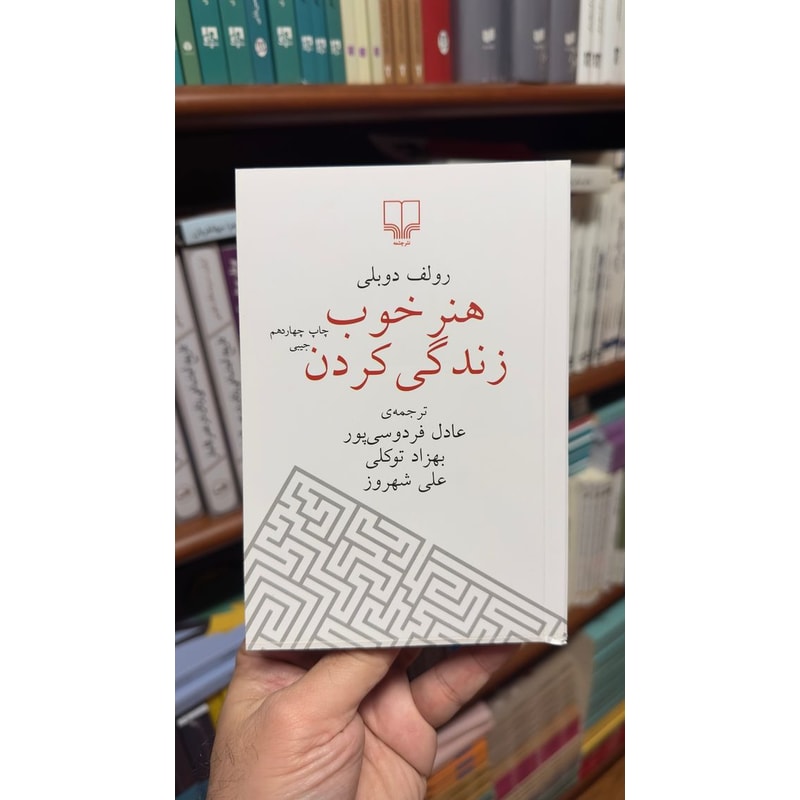


هنر خوب زندگی کردن
The Art of the Good Life
$ 38,95
«هنر خوب زندگی کردن» اثر رولف دوبلی (Rolf Dobelli) با ترجمهٔ عادل فردوسیپور (Adel Ferdosipour)، بهزاد توکلی نیشابوری (Behzad Tavakoli Neishabouri) و علی شهروز ستوده (Ali Shahrooz Sotoodeh) از نشر چشمه، پنجاهودو ابزار ذهنی را برای سنجیدن تصمیم، توجه، توقع، پول و معنای موفقیت پیش میگذارد. عنوان، نقشها، ناشر و شابک تأیید شدهاند؛ جزئیات چاپی نسخهٔ موجود تا تطبیق شناسنامه قطعی نیست.
The Art of the Good Life by Rolf Dobelli, translated into Persian by Adel Ferdosipour, Behzad Tavakoli Neishabouri and Ali Shahrooz Sotoodeh for Nashr-e Cheshmeh, presents fifty-two mental tools for examining decisions, attention, expectations, money and the meaning of success. Title, roles, publisher and ISBN are confirmed; print-specific details remain unsettled until the stocked copy is checked.
موجود
معرفی کتاب هنر خوب زندگی کردن
«هنر خوب زندگی کردن» نوشتهٔ رولف دوبلی (Rolf Dobelli) و ترجمهٔ عادل فردوسیپور (Adel Ferdosipour)، بهزاد توکلی نیشابوری (Behzad Tavakoli Neishabouri) و علی شهروز ستوده (Ali Shahrooz Sotoodeh) است و نشر چشمه آن را به فارسی منتشر کرده است. شابک این ویرایش فارسی 978-600-229-962-8 است. عنوان دقیق بازار فقط «هنر خوب زندگی کردن» است؛ نام نویسنده یا مترجمان نباید به عنوان فارسی کتاب چسبانده شود.
کتاب در پنجاهودو فصل کوتاه، مجموعهای از ابزارهای ذهنی برای سنجیدن انتخابها، توجه، توقع، پول، حسادت، نگرانی و معنای موفقیت پیشنهاد میکند. وعدهٔ یک نسخهٔ قطعی برای خوشبختی در کار نیست. ساختار اثر بیشتر شبیه جعبهابزاری است که خواننده میتواند هر ایده را در موقعیت مناسب آزمایش کند.
از عنوان آلمانی تا ویرایش انگلیسی
اثر در سال ۲۰۱۷ با عنوان آلمانی Die Kunst des guten Lebens: 52 überraschende Wege zum Glück منتشر شد. عنوان شناختهشدهٔ انگلیسی آن The Art of the Good Life است و عنوان کتابشناختی کامل یک ویرایش انگلیسی The Art of the Good Life: Clear Thinking for Business and a Better Life ثبت شده است.
عدد پنجاهودو به ساختار خود اثر تعلق دارد: فصلهایی مستقل و کوتاه که هرکدام یک مدل ذهنی یا قاعدهٔ عملی را بررسی میکنند. تاریخ ۲۰۱۷ تاریخ انتشار اثر اصلی است، نه ادعایی دربارهٔ سال یا نوبت چاپ کالای فارسی موجود در انبار.
زندگی خوب یک فرمول واحد ندارد
نقطهٔ آغاز کتاب این است که پرسش «چگونه باید زندگی کرد؟» با یک اصل جادویی پاسخ داده نمیشود. زندگی از سلامت، رابطه، کار، اختیار، بخت، پول، زمان و ارزشهای گاه متعارض ساخته شده است؛ به همین دلیل یک قاعده نمیتواند همهٔ موقعیتها را حل کند.
رویکرد عملیتر، داشتن چند ابزار محدود و روشن است: بعضی برای جلوگیری از خطا، بعضی برای حفاظت از توجه و بعضی برای تعیین مرز. ابزار مناسب احتمال انتخاب بهتر را بالا میبرد، اما آینده را تضمین نمیکند و مسئولیت قضاوت را از دوش خواننده برنمیدارد.
حسابداری ذهنی و هنر اصلاحکردن
ذهن پول، زمان و خطا را همیشه در یک دفتر منصفانه ثبت نمیکند. زیان کوچک میتواند ساعتها توجه را بسوزاند و یک اشتباه قدیمی ممکن است فقط به دلیل غرور ادامه یابد. کتاب پیشنهاد میکند هزینهٔ روانیِ پیگیری هر مسئله را نیز کنار هزینهٔ مالی آن ببینیم.
اصلاح مسیر نشانهٔ شکست شخصیت نیست. تصمیم خوب در یک لحظه با اطلاعات محدود گرفته میشود و بعد باید با واقعیت تازه بهروز شود. کسی که برای تغییرنظر هزینهٔ حیثیتی سنگینی میسازد، خود را به نسخهٔ قدیمی تصمیمش زندانی میکند.
تفکر جعبهسیاه و یادگیری از نتیجه
پس از یک تصمیم مهم، فقط پایان خوش یا تلخ را نبینیم. فرضها، اطلاعات در دسترس، مسیر استدلال و نشانههایی را که نادیده گرفته شدند ثبت کنیم. چنین پروندهای کمک میکند فرق میان بدشانسی، فرایند ضعیف و دانشی را که بعداً به دست آمده تشخیص دهیم.
بازبینی صادقانه باید برای موفقیت هم انجام شود. نتیجهٔ خوب ممکن است حاصل شانس باشد و اگر به عنوان اثبات مهارت ثبت شود، دور بعد اعتمادبهنفس بیشازحد میسازد. یادگیری زمانی دقیقتر است که فرایند و نتیجه جداگانه ارزیابی شوند.
هنر منفی: چه چیزی را باید حذف کرد؟
بخشی از زندگی خوب از افزودن هدفهای تازه نمیآید، بلکه از کمکردن منابع رنج قابلپیشگیری شکل میگیرد: بدهی بیحساب، رابطهٔ فرساینده، تعهد غیرضروری، خبر و حواسپرتی بیپایان یا کاری که بیرون از توان واقعی ماست.
پیشگیری معمولاً هیجان کمتری از نجاتدادن یک بحران دارد، اما نتیجهٔ پایدارتر میسازد. پرسش کاربردی این است: کدام مشکل تکراری را میتوان با طراحی محیط، یک مرز روشن یا یک تصمیم زودهنگام اصلاً به وجود نیاورد؟
تمرکز، توجه و محوشدن لذت خرید
آنچه در مرکز توجه قرار میگیرد، موقتاً بزرگتر از سهم واقعیاش در زندگی دیده میشود. یک ناراحتی، وسیلهٔ تازه یا مقایسهٔ اجتماعی میتواند تمام تصویر را اشغال کند. بهتر است پیش از تصمیم بپرسیم این موضوع در یک هفتهٔ عادی واقعاً چند ساعت از تجربهٔ ما را تغییر میدهد.
لذت بسیاری از خریدها با عادتکردن کاهش مییابد، در حالی که هزینه، نگهداری و توجه لازم باقی میماند. کتاب ارزش توجه را مانند منبعی محدود میبیند: چیزی که پیوسته آن را مصرف میکند باید فایدهای متناسب با این هزینه داشته باشد.
دایرهٔ توانایی، تعهد و «نه» سریع
دانستن مرز توانایی به معنای کوچککردن آرزوها نیست؛ یعنی تشخیص دهیم کجا تجربه و فهم کافی داریم و کجا باید یاد بگیریم، مشورت کنیم یا کنار بکشیم. تصمیم بیرون از این دایره اگر با قطعیت نمایشی همراه شود، ریسک پنهان را بیشتر میکند.
برای هدفهای مهم، تعهد روشن میتواند از مذاکرهٔ روزانه با خود جلوگیری کند. در مقابل، درخواستهای کمارزش را باید زود سنجید. «نه» گفتن محترمانه در چند ثانیه گاهی بهتر از «شاید»ی است که هفتهها زمان و تمرکز را معلق نگه میدارد.
پول، استقلال و مسابقهای که پایان ندارد
پول تا جایی ارزشمند است که امنیت و اختیار واقعی بسازد. اگر تنها به نشاندادن جایگاه تبدیل شود، خط پایان با هر مقایسه عقبتر میرود. هزینهٔ سبک زندگی بالا میرود و استقلالی که پول قرار بود بسازد، جای خود را به اجبار برای حفظ ظاهر میدهد.
رقابتهای منزلتی شبیه مسابقهٔ تسلیحاتیاند: همه بیشتر خرج میکنند و کمتر کسی واقعاً جلو میافتد. تعریف «کافی» و جداکردن نیاز از نمایش، راهی برای خارجشدن از مسابقهای است که معیارش را دیگران تعیین میکنند.
حسادت، شهرت و مسابقه با خود
حسادت معمولاً در مقایسه با نزدیکان و همتایان شدیدتر میشود، زیرا فاصلهٔ آنان قابلتصور است. انکار این احساس آن را حذف نمیکند. میتوان آن را به نشانه تبدیل کرد: دقیقاً چه چیزی مطلوب است و آیا واقعاً با ارزشها و هزینههای زندگی ما سازگار است؟
شهرت نیز سرمایهای شکننده است. اگر هر انتخاب برای نگاه بیرونی انجام شود، آزادی تصمیم کوچک میشود. معیار شخصیِ روشن—مهارتی که بهتر شده، کاری که با کیفیت انجام شده یا رابطهای که حفظ شده—مسابقه را از جدول دیگران به مسیر خود فرد برمیگرداند.
دو «خود»: تجربه و حافظه
خودی که اکنون تجربه میکند با خودی که بعداً داستان زندگی را به یاد میآورد یکسان عمل نمیکند. حافظه چند لحظهٔ برجسته و پایان یک دوره را پررنگ میکند، اما ساعتهای معمولی را کنار میگذارد. تصمیم صرفاً برای ساختن خاطره ممکن است کیفیت تجربهٔ روزمره را قربانی کند.
زندگینامهای که برای خود میسازیم نیز انتخابی و مرتبشده است. داستان منسجم مفید است، اما نباید جای واقعیت پیچیده را بگیرد. ثبت تجربههای عادی و سنجیدن حالِ واقعی در کنار خاطرهٔ آینده، تصویر متعادلتری میسازد.
نگرانی، استحکام ذهنی و دایرهٔ کرامت
نگرانیِ بیزمان و بیمرز میتواند تمام روز را اشغال کند. نوشتن مسئله، جداکردن بخش قابلکنترل و تعیین زمانی مشخص برای بازبینی، آن را از صدای مبهم به مسئلهای محدود تبدیل میکند. بعضی نگرانیها اقدام میخواهند و بعضی فقط باید تحمل شوند.
استحکام ذهنی به معنای بیاحساسی نیست. یعنی ارزشهایی تعریف کنیم که در فشار هم فروخته نشوند و برایشان مرز بگذاریم. این دایرهٔ کرامت کمک میکند بدانیم کدام سود، شهرت یا راحتی ارزش عبور از اصول بنیادی را ندارد.
لذت، معنا و موفقیت درونی
لذت لحظهای و زندگی معنادار دشمن هم نیستند، اما یکی جای دیگری را پر نمیکند. رضایت میتواند از تجربهٔ خوشایند، رابطه، مهارت، خدمت، آزادی یا پیگیری کاری ارزشمند بیاید. ترکیب مناسب برای هر فرد و هر دورهٔ زندگی متفاوت است.
موفقیت درونی بر چیزهایی تکیه میکند که کمتر در اختیار تصادف و داوری بیرونیاند: کیفیت کار، صداقت فرایند، انتخاب همراهان و نحوهٔ استفاده از توجه. نتیجههای بیرونی مهماند، اما نباید تنها داور ارزش زندگی باشند.
مدیریت انتظار و تصمیم در جهان ناکامل
فاصلهٔ میان انتظار و واقعیت بخش بزرگی از ناامیدی را میسازد. پایینآوردن کورکورانهٔ انتظار راهحل نیست؛ بهتر است احتمالها، محدودیتها و تعریف یک نتیجهٔ قابلقبول از پیش روشن شوند. آنگاه موفقیت با معیار واقعی سنجیده میشود، نه با خیال پس از نتیجه.
در انتخابهای متعدد نیز جستوجوی بیپایان هزینه دارد. میتوان معیارهای ضروری را تعریف کرد، چند گزینهٔ کافی را سنجید و وقتی آستانه برآورده شد تصمیم گرفت. هدف یافتن گزینهای مناسب است، نه اثبات اینکه هیچ گزینهٔ بهتری در جهان وجود ندارد.
نظر، جزماندیشی و رژیم اطلاعات
داشتن نظر دربارهٔ هر موضوع نشانهٔ آگاهی نیست. بعضی پرسشها دادهٔ کافی ندارند و گفتن «نمیدانم» ظرفیت ذهنی را حفظ میکند. نظرهایی که به هویت گره میخورند سختتر اصلاح میشوند، چون تغییرشان مانند تهدیدی علیه خود فرد احساس میشود.
ورودی اطلاعات نیز باید انتخاب شود. بیشترخواندن همیشه به فهم بیشتر نمیانجامد؛ گاهی خواندن دوبارهٔ یک متن ارزشمند، آزمودن ایده و مقایسه با شواهد مخالف بهتر از انباشتن دهها عنوان نیمهخوانده است.
اصالت، خودشناسی و دیدن از جای دیگری
فرمان سادهٔ «همیشه خودت باش» نادیده میگیرد که انسان نقشهای متعدد دارد و شناختش از انگیزههای خود کامل نیست. احساس درونی یک داده است، نه حکم نهایی. رفتار واقعی، بازخورد قابلاعتماد و نتیجههای تکرارشونده اطلاعاتی میدهند که شهود تنها نمیدهد.
برای فهم دیگری نیز تصور سطحی کافی نیست. باید محدودیتها، اطلاعات و هزینههایی را که او میبیند بازسازی کنیم. این تمرین اختلاف ارزشها را حذف نمیکند، اما قضاوت عجولانه را کمتر و امکان گفتوگوی دقیقتر را بیشتر میکند.
بخت، نقطهٔ آغاز و باور به جهان عادل
محل تولد، خانواده، بدن، زمان تاریخی و فرصتهای اولیه انتخاب فرد نیستند. دیدن سهم بخت نه تلاش را بیمعنا میکند و نه مسئولیت را حذف؛ فقط مانع میشود موفقیت را تماماً شایستگی و شکست را تماماً نقص اخلاقی بدانیم.
باور به اینکه جهان همیشه پاداش و مجازات عادلانه میدهد، میتواند رنج دیگران را به داوری اخلاقی تبدیل کند. نگاه واقعبینانهتر هم عاملیت فرد را میبیند و هم ساختار، تصادف و محدودیت را. این ترکیب برای قضاوت و کمککردن منصفانهتر است.
چگونه کتاب را به ابزار عملی تبدیل کنیم؟
لازم نیست پنجاهودو ایده یکباره حفظ شوند. سه مسئلهٔ تکراری زندگی را انتخاب کنید و برای هرکدام یک ابزار بنویسید: یک مرز برای توجه، یک قاعده برای تصمیم مالی و یک روش برای بازبینی خطا. زمان و نشانهٔ اجرای هر ابزار را نیز مشخص کنید.
پس از چند هفته نتیجه را با سؤالهای روشن بسنجید: آیا تصمیم سریعتر یا بهتر شد؟ چه هزینهٔ تازهای ساخت؟ در چه موقعیتی کار نکرد؟ ابزار ذهنی باید قابلاصلاح باشد. اگر به شعار هویتی تبدیل شود، همان انعطافی را از بین میبرد که قرار بود بسازد.
مرزهای کتاب و خواندن انتقادی
این اثر یک راهنمای عمومی و خوشخوان است، نه کتاب درسی جامع فلسفه یا روانشناسی و نه درمان. هر فصل ایدهای فشرده عرضه میکند؛ برای تصمیمهای پزشکی، حقوقی، مالی یا روانی پرخطر باید به شواهد تخصصی و فرد واجدصلاحیت مراجعه کرد.
همهٔ ابزارها برای همهٔ فرهنگها، منابع و شرایط به یک شکل اجراشدنی نیستند. خواندن انتقادی یعنی مثال را از اصل جدا کنیم، هزینههای پنهان را ببینیم و توصیه را پیش از تعمیم در مقیاسی کوچک بیازماییم. کتاب احتمال یک انتخاب بهتر را بالا میبرد، نه اینکه زندگی خوب را تضمین کند.
ترجمهٔ فارسی نشر چشمه
نسخهٔ حاضر کار مشترک عادل فردوسیپور (Adel Ferdosipour)، بهزاد توکلی نیشابوری (Behzad Tavakoli Neishabouri) و علی شهروز ستوده (Ali Shahrooz Sotoodeh) است. فهرستهای معتبر بازار هر سه نفر را مترجم و رولف دوبلی (Rolf Dobelli) را نویسنده ثبت میکنند؛ بنابراین فقط پیوند نویسنده باید نقش نویسنده داشته باشد.
روی جلد فعلی، نام دو مترجم به صورت کوتاهتر «بهزاد توکلی» و «علی شهروز» دیده میشود. برای مسیریابی دقیق صفحات پدیدآورندگان، این صفحه صورتهای کامل کتابشناختی بهزاد توکلی نیشابوری (Behzad Tavakoli Neishabouri) و علی شهروز ستوده (Ali Shahrooz Sotoodeh) را نگه میدارد و نام انگلیسی هر شخص را نیز کنار آن میآورد.
اختلاف چاپها و مرز اطلاعات قطعی
عنوان فارسی، عنوانهای آلمانی و انگلیسی، نام نویسنده، سه مترجم، نشر چشمه و شابک در منابع همخواناند. در مقابل، رکوردهای متصل به همین شابک دربارهٔ صفحهشماری، تاریخ و نوبت چاپ و حتی جلد نسخهها یکسان نیستند.
به همین دلیل هیچ عدد یا ویژگی چاپی به کالای فعلی نسبت داده نمیشود. تعداد صفحه، سال انتشار این نسخهٔ فارسی، نوبت چاپ، نوع جلد و اندازهٔ فیزیکی فقط با دیدن شناسنامه و خودِ نسخهٔ موجود در انبار قطعی میشوند. این مرز از ترکیب اطلاعات چاپهای متفاوت و معرفی نادرست نسخهٔ تحویلی جلوگیری میکند.
این کتاب برای چه خوانندهای مناسب است؟
کتاب میتواند برای خوانندگان علاقهمند به خودشناسی، تصمیمگیری، فلسفهٔ کاربردی، روانشناسی عامهفهم و طراحی سبک زندگی مناسب باشد؛ بهویژه کسی که فصلهای کوتاه و ایدههای قابلآزمایش را به یک روایت طولانی ترجیح میدهد.
بهترین استفاده، انتخاب گزینشی و سنجیده است: هر ابزار را با شرایط واقعی، ارزشهای شخصی و پیامدهایش بسنجید. هدف ساختن قضاوت مستقلتر است، نه جایگزینکردن یک مجموعه دستور تازه به جای فکرکردن.
مشخصات کتاب | Book Details
| عنوان دقیق فارسی / Exact Persian Title | هنر خوب زندگی کردن |
|---|---|
| عنوان انگلیسی / English Title | The Art of the Good Life |
| عنوان کامل یک ویرایش انگلیسی / Full English Edition Title | The Art of the Good Life: Clear Thinking for Business and a Better Life |
| عنوان اصلی آلمانی / Original German Title | Die Kunst des guten Lebens: 52 überraschende Wege zum Glück |
| نویسنده / Author | رولف دوبلی (Rolf Dobelli) |
| مترجمان فارسی / Persian Translators | عادل فردوسیپور (Adel Ferdosipour)، بهزاد توکلی نیشابوری (Behzad Tavakoli Neishabouri) و علی شهروز ستوده (Ali Shahrooz Sotoodeh) |
| ناشر نسخهٔ فارسی / Persian Publisher | نشر چشمه / Nashr-e Cheshmeh |
| شابک / ISBN | 978-600-229-962-8 |
| زبان نسخه / Edition Language | فارسی / Persian |
| ساختار اثر / Structure | پنجاهودو فصل کوتاه و ابزار ذهنی / fifty-two short chapters and mental tools |
| تاریخچهٔ اثر / Work History | انتشار اثر اصلی آلمانی در سال ۲۰۱۷؛ نه مشخصات چاپ نسخهٔ موجود / original German work published in 2017; not a stocked-copy printing claim |
| مشخصات نسخهٔ موجود / Stock-copy Details | تعداد صفحه، سال انتشار این نسخهٔ فارسی، نوبت چاپ، نوع جلد و اندازهٔ فیزیکی فقط با دیدن شناسنامه و خودِ نسخهٔ موجود در انبار قطعی میشوند / Pagination, this Persian copy’s publication year, printing number, binding and physical dimensions require the colophon and direct inspection of the copy currently in stock |
| موضوع / Subjects | خودشناسی، تصمیمگیری، فلسفهٔ کاربردی، روانشناسی عامهفهم و سبک زندگی / self-knowledge, decision-making, practical philosophy, accessible psychology and lifestyle design |
About The Art of the Good Life
The Art of the Good Life is written by Rolf Dobelli and translated into Persian by Adel Ferdosipour, Behzad Tavakoli Neishabouri and Ali Shahrooz Sotoodeh. Nashr-e Cheshmeh publishes this Persian edition, identified by ISBN 978-600-229-962-8. Its exact market title is هنر خوب زندگی کردن; author and translator names should not be appended to the Persian H1.
Across fifty-two short chapters, the book offers mental tools for examining choice, attention, expectation, money, envy, worry and the meaning of success. It does not promise one certain recipe for happiness. The structure is closer to a toolbox whose ideas can be tested where they fit.
From the German title to the English edition
The work appeared in 2017 as Die Kunst des guten Lebens: 52 überraschende Wege zum Glück. Its established English title is The Art of the Good Life; one full bibliographic English title is The Art of the Good Life: Clear Thinking for Business and a Better Life.
The number fifty-two belongs to the work’s structure: independent, compact chapters, each examining a mental model or practical rule. The 2017 date describes the original work’s publication history, not the year or printing of the Persian copy currently in stock.
A good life has no single formula
The book begins from the idea that “How should one live?” cannot be answered by a magic principle. Life combines health, relationships, work, autonomy, luck, money, time and sometimes conflicting values; one rule cannot resolve every situation.
A more practical approach keeps several limited, clear tools: some prevent avoidable error, some protect attention, and others set boundaries. The right tool may improve the odds of a better choice, but it cannot guarantee the future or remove the reader’s responsibility to judge.
Mental accounting and the skill of correction
The mind does not always record money, time and error in a fair ledger. A small loss can consume hours of attention, while an old mistake may continue merely because pride resists changing course. The psychological cost of pursuing an issue belongs beside its financial cost.
Correction is not a failure of character. A reasonable decision is made at one moment with limited information and should be updated when reality changes. Anyone who makes changing their mind reputationally expensive becomes trapped by an earlier version of the choice.
Black-box thinking and learning from outcomes
After an important decision, do not look only at whether the ending felt good or bad. Record the assumptions, available information, reasoning process and signals that were missed. Such a record helps separate bad luck, a weak process and knowledge acquired only afterwards.
Success deserves the same honest review. A good outcome may contain luck; treating it as proof of skill can manufacture overconfidence for the next round. Learning becomes more accurate when process and outcome are assessed separately.
The negative art: what should be removed?
Part of a good life comes not from adding new goals but from reducing preventable sources of misery: uncontrolled debt, a corrosive relationship, needless commitments, endless news and distraction, or work far beyond one’s real competence.
Prevention attracts less attention than rescuing a crisis, yet it often creates a more durable result. A practical question is: which recurring problem could be prevented altogether through environmental design, a clear boundary or an earlier decision?
Focus, attention and the fading pleasure of acquisition
Whatever occupies the centre of attention temporarily looks larger than its actual share of life. A discomfort, new possession or social comparison can fill the whole picture. Before choosing, ask how many hours of an ordinary week the matter will truly change.
Pleasure from many purchases fades through adaptation while cost, maintenance and required attention remain. The book treats attention as a scarce resource: anything that consumes it continuously should return value proportionate to that cost.
The circle of competence, commitments and a quick no
Knowing the boundary of competence does not mean shrinking ambition. It means recognising where experience and understanding are adequate and where learning, advice or withdrawal is required. A confident performance outside that circle can conceal rather than reduce risk.
A clear commitment can end daily renegotiation over an important goal. Low-value requests require the opposite discipline: assess them early. A courteous no delivered quickly may be kinder than a maybe that suspends time and attention for weeks.
Money, autonomy and the race without a finish line
Money is valuable when it creates genuine security and freedom. When it becomes mainly a display of rank, the finish line recedes with every comparison. Lifestyle costs rise, and the autonomy money was meant to provide becomes an obligation to preserve appearances.
Status competitions resemble arms races: everyone spends more and few become meaningfully better off. Defining enough and separating need from display offers an exit from a contest whose standards are set by other people.
Envy, reputation and running one’s own race
Envy is often strongest towards peers because their distance feels imaginable. Denying the feeling does not remove it. It can instead become information: what exactly appears desirable, and does it fit one’s values and the real costs of one’s life?
Reputation is fragile capital. When every choice serves an outside audience, freedom narrows. A personal measure—improved skill, work completed well or a relationship responsibly maintained—moves the race from someone else’s scoreboard back to one’s own course.
Two selves: experience and memory
The self having an experience and the self later remembering a life do not operate identically. Memory emphasises a few peaks and endings while discarding ordinary hours. A decision made only to create a memorable story can sacrifice the quality of daily experience.
The autobiography we tell ourselves is also selected and arranged. A coherent story can be useful, but it should not replace complex reality. Recording ordinary experience and weighing the present alongside the future memory produces a more balanced picture.
Worry, mental resilience and the circle of dignity
Worry without a boundary or schedule can occupy an entire day. Writing down the problem, separating its controllable part and assigning a time for review turns an indistinct noise into a limited task. Some worries call for action; others have to be endured.
Mental resilience is not emotional numbness. It means defining values that will not be sold under pressure and placing boundaries around them. A circle of dignity clarifies which profit, reputation or convenience is not worth crossing a basic principle to obtain.
Pleasure, meaning and inner success
Immediate pleasure and a meaningful life are not enemies, but one cannot fill the place of the other. Satisfaction may arise from enjoyable experience, relationships, skill, service, freedom or sustained work on something valuable. The right mixture changes across people and stages of life.
Inner success rests on matters less controlled by accident and outside judgement: quality of work, integrity of process, choice of companions and use of attention. External results still matter, but they should not be the only judges of a life’s value.
Managing expectations in an imperfect world
The gap between expectation and reality generates much disappointment. Blindly lowering expectations is not the answer; probabilities, constraints and an acceptable outcome should be clarified in advance. Success can then be judged against a real standard rather than a fantasy invented afterwards.
Endless searching also imposes a cost when many options exist. Define the essential criteria, compare a workable set and decide once the threshold is met. The aim is a suitable choice, not proof that no better option exists anywhere in the world.
Opinion, dogma and an information diet
Having an opinion on every subject is not evidence of knowledge. Some questions lack adequate data, and saying “I do not know” preserves mental capacity. Views tied to identity become harder to correct because revision feels like a threat to the self.
Information inputs also require selection. Reading more does not always create more understanding. Re-reading a worthwhile text, testing an idea and comparing it with opposing evidence may be better than accumulating dozens of half-read titles.
Authenticity, self-knowledge and another person’s perspective
The simple instruction to “always be yourself” ignores that people inhabit several roles and understand their own motives imperfectly. An inner feeling is evidence, not a final verdict. Actual behaviour, trustworthy feedback and repeated outcomes reveal things intuition alone does not.
Understanding another person also requires more than superficial imagination. Reconstruct the constraints, information and costs they perceive. The exercise cannot erase differences in values, but it can reduce hasty judgement and make a more precise conversation possible.
Luck, starting points and belief in a just world
Birthplace, family, body, historical moment and initial opportunity are not chosen. Recognising luck neither makes effort meaningless nor removes responsibility; it prevents us from treating success as pure merit and failure as a complete moral defect.
Belief that the world always rewards and punishes fairly can turn another person’s suffering into a moral judgement. A more realistic view holds agency together with structure, accident and constraint. That combination supports fairer judgement and more useful help.
Turning the book into a practical tool
There is no need to memorise all fifty-two ideas at once. Choose three recurring problems and assign one tool to each: a boundary for attention, a rule for a financial choice and a method for reviewing error. Define when and how each tool will be used.
After several weeks, evaluate it with clear questions. Did the choice become faster or better? What new cost appeared? Where did the tool fail? A mental model should remain revisable. Turned into an identity slogan, it destroys the flexibility it was meant to create.
Limits and critical reading
This is an accessible general guide, not a comprehensive textbook of philosophy or psychology and not a treatment. Each chapter compresses an idea; high-stakes medical, legal, financial or mental-health decisions require specialist evidence and an appropriately qualified professional.
Not every tool is equally practical across cultures, resources and circumstances. Critical reading separates example from principle, looks for hidden costs and tests advice on a small scale before generalising it. The book may improve the odds of a better choice; it cannot guarantee a good life.
The Cheshmeh Persian translation
This edition is a joint translation by Adel Ferdosipour, Behzad Tavakoli Neishabouri and Ali Shahrooz Sotoodeh. Established market catalogues identify all three as translators and Rolf Dobelli as the author; only the author link should therefore carry the author role.
The current cover shortens two translator names to بهزاد توکلی and علی شهروز. For precise creator-page routing, this page keeps the full bibliographic forms بهزاد توکلی نیشابوری (Behzad Tavakoli Neishabouri) and علی شهروز ستوده (Ali Shahrooz Sotoodeh), with an English form beside every Persian name.
Conflicting print records and the evidence boundary
The Persian, German and English titles, author, three translators, Nashr-e Cheshmeh publisher and ISBN agree across the sources. Records attached to the same ISBN do not agree on pagination, publication and printing dates, or even the bindings of individual copies.
No such print-specific value is therefore assigned to the current product. Pagination, this Persian copy’s publication year, printing number, binding and physical dimensions require the colophon and direct inspection of the copy currently in stock. This boundary prevents details from different printings being combined and attached to the copy actually supplied.
Who may appreciate this book?
The book may suit readers interested in self-knowledge, decision-making, practical philosophy, accessible psychology and lifestyle design—especially those who prefer short chapters and testable ideas to one extended narrative.
Its strongest use is selective and reflective: test each tool against real circumstances, personal values and consequences. The aim is more independent judgement, not replacing thought with another collection of instructions.
نظر، اصلاح و تکمیل محتوا
اصلاح اطلاعات یا ارسال نظر درباره این کتاب
اصلاح اطلاعات یا ارسال نظر درباره کتاب «هنر خوب زندگی کردن»
اگر درباره مشخصات، تاریخها، نامها، منابع یا محتوای این صفحه اصلاح مستندی دارید، لطفاً پیام خود و منبع اطلاعات را ارسال کنید. پیامها پیش از اعمال تغییر بررسی میشوند.
If you have a documented correction, reliable source or additional information about this page, please send it below. All submissions are reviewed before any changes are made.
.فقط مشتریانی که این محصول را خریداری کرده اند و وارد سیستم شده اند میتوانند برای این محصول دیدگاه(نظر) ارسال کنند.






نقد و بررسیها
هنوز بررسیای ثبت نشده است.