Childhood and a literary household in Isfahan
Mohammad Hoqouqi was born in Isfahan on 3 May 1937, corresponding to 13 Ordibehesht 1316. He completed primary and secondary school in his home city. Bukhara’s account of the 2008 tribute to Hoqouqi describes a household oriented toward culture and literature and traces his literary curiosity to his school years. The selected reliable sources do not identify his parents, siblings, spouse or children. This profile leaves those relationships undocumented rather than guessing names.
Higher education and a Tehran literary network
Hoqouqi entered Daneshsara-ye Ali in 1337; the institution was renamed the Faculty of Letters the following year. He studied with Jalal al-Din Homaei, Mohammad Moin, Parviz Natel Khanlari and Mohammad Moqaddam. His first poems appeared in 1338 and 1339, when he also formed literary relationships with Nader Naderpour, Simin Behbahani, Siavash Kasrai, Manouchehr Atashi and Bahram Sadeghi.
Teaching and the formation of Jong-e Isfahan
After graduating, Hoqouqi returned to Isfahan and began teaching at two leading secondary schools in 1341. His engagement with the Saeb literary association, Hamid Mosaddegh and a younger group of writers and translators contributed to the formation of Jong-e Isfahan. Hoqouqi, Houshang Golshiri, Mohammad Kalbasi, Fereydoun Mokhtarian and Jalil Doustkhah formed its first editorial board, and the first issue appeared in summer 1344. Ahmad Golshiri, Abolhassan Najafi and Ahmad Miralaei later expanded the circle. Doustkhah described Hoqouqi as a founding and influential participant in the eleven issues published between 1344 and 1360.
Three influential critical essays
“Who Is Dead? Who Remains?” appeared in 1345, followed by “From Source to Estuary” in 1347. “From Showing to Poetry” joined them as one of Hoqouqi’s most discussed interventions in the language, structure and evaluation of modern Persian poetry. Radio Farda reported that these essays acquired an importance comparable to enduring books of modern literary criticism. His aim was not simply to rank poets but to build a coherent critical vocabulary for reading new poetry.
Poetry collections and a distinctive voice
The collections Zavaya va Madarat and Fasl-ha-ye Zemestani appeared in 1348 and opened a new stage in Hoqouqi’s poetry. Sharqi-ha followed in 1351, along with a journey to England and an association with Mohammad Jafar Mahjoub. Later collections included Gorizha-ye Nagozir, Ba Shab Ba Zakhm Ba Gorg and Khorus-e Hezar-Bal. At the 2008 tribute, Javad Mojabi emphasised Hoqouqi’s musical phrasing, sensitivity to individual words and the architectural structure of both his qasidas and modern poems.
Research, censorship and anthology
In 1353 and 1354 Hoqouqi prepared research on changes in school literature textbooks under the title She’r o Nasr-e Mo’aser. It did not initially receive publication approval. Bukhara records that permission was granted in 1356 after a recommendation by Parviz Natel Khanlari. Hoqouqi also compiled She’r-e No az Aghaz ta Emruz, an anthology accompanied by an extended account of modern Persian poetry, its development and the criteria behind his selections. Contemporary reports describe it as one of his most important works of literary mapping and criticism.
Poetry of Our Time and the Forugh Farrokhzad volume
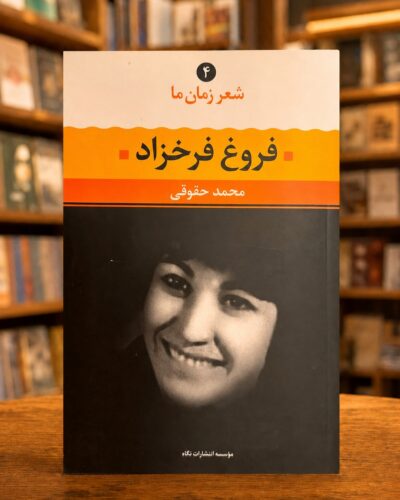
In the Poetry of Our Time series, Hoqouqi studied the structures and defining features of poetry by Ahmad Shamlou, Mehdi Akhavan-Sales, Sohrab Sepehri, Forugh Farrokhzad and Nima Yushij. Poetry of Our Time, Volume 4: Forugh Farrokhzad was first published in 1372, corresponding to 1993. Its full Persian bibliographic title is “فروغ فرخزاد: شعر فروغ فرخزاد از آغاز تا امروز، شعرهای برگزیده، تفسیر و تحلیل موفقترین شعرها”. It follows Farrokhzad’s development from the early collections through Another Birth and Let Us Believe in the Beginning of the Cold Season, combining critical interpretation with selected poems. Bibliographic records for this edition credit Hoqouqi as the author, critic and compiler, while Farrokhzad is the poet of the selected poems, the central subject and a contributing creator.
The 2008 tribute and literary relationships
On 1 June 2008, the sixty-second Bukhara Night honoured Hoqouqi shortly after his seventieth birthday. Javad Mojabi described him as a complete cultural intellectual and an outstanding poet, critic and researcher. Mahmoud Dowlatabadi discussed the historical memory carried by his language, while Jalil Doustkhah recalled his role in Jong-e Isfahan and in opening modern Persian poetry to careful critical reading. The event presented Hoqouqi as a connector among Isfahan, Tehran and several generations of poets and writers.
Illness, death and an explicit evidence boundary
Hoqouqi died in Isfahan on 29 June 2009, corresponding to 8 Tir 1388, after a period of illness. He was seventy-two. Radio Farda attributed his death to heart disease. Voice of America reported the preceding illness but gave no specific medical cause. Wikidata lists cirrhosis, but that statement had no citation when this profile was researched. No cause of death is therefore emitted in structured data, and the prose preserves the source conflict instead of presenting an uncertain diagnosis as fact.